How to Create AI Employees with Personalized Agents Using SIMI
Building an AI-powered company starts with creating the right AI workforce.
Instead of depending on one general-purpose AI assistant for every responsibility, SIMI allows you to create personalized special agents that can serve as specialized AI employees. Each employee can be given a name, role, responsibilities, and custom description.
In this guide, we demonstrate the first stage of building a fictional 100% AI company called Veridata inside the SIMI platform.
Our objective is to create 24 AI employees, each with different roles and responsibilities. These employees will later perform tasks, share information, review work, participate in group workflows, and collaborate autonomously.
Watch the video above to see Part 1 of the Veridata AI company demonstration in action.
Building the Veridata AI Workforce
We begin by logging into the SIMI application and navigating to the API Keys section.
From there, we go to Configure API Key and select the Agent icon.
This is where we begin creating our personalized AI employees.
Creating the First Employee
Our first employee is the Chief Executive Officer.
We enter the employee's name and provide a custom description explaining the responsibilities and tasks the CEO will perform.
The purpose of the description is to give the employee a clearly defined role inside Veridata.
After entering the required information, we click Create Agent.
Our first employee has now been successfully created.
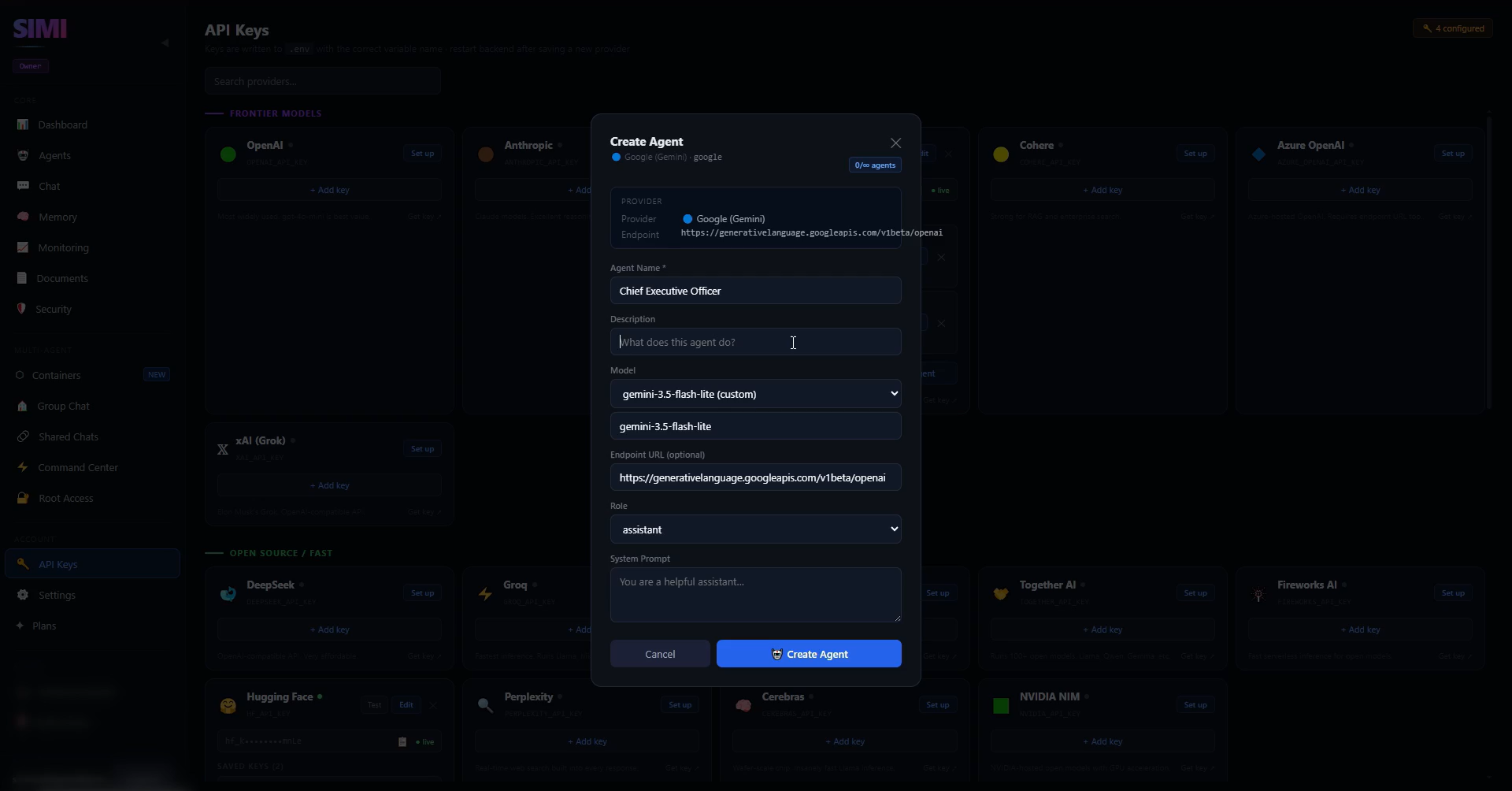
The Create Agent dialog for the Chief Executive Officer, with its name, model, and description filled in.
Creating the Chief Operating Officer
We then create our second employee, the Chief Operating Officer.
Again, we enter the employee's name and provide a custom description outlining the responsibilities of the COO.
Once the information is complete, we click Create Agent.
Our second employee is now available.
Creating the Operations Manager
The third employee we create is the Operations Manager.
We add the employee's name and provide a custom description that matches the role and responsibilities of the Operations Manager.
We then click Create Agent.
At this point, we have established the basic process for building an AI employee.
Creating the Remaining 21 Employees
Now that the process is clear, we can quickly add the remaining 21 employees.
Each employee receives a different role and a custom description outlining their specific responsibilities within Veridata.
This gives us a total of 24 AI employees.
The purpose is not simply to create a large number of agents. Each employee forms part of the company's organizational structure.
The employees can represent different functions, including leadership, operations, research, project coordination, field work, sales, verification, data operations, finance, and administration.
Verifying the AI Employees
After creating all 24 employees, we move to the Agents section.
Here, we verify that all 24 employees have been successfully created.
We also check that the description assigned to each employee matches the employee's role and responsibilities.
This step is important because the description helps establish what each personalized agent is intended to do within the company.
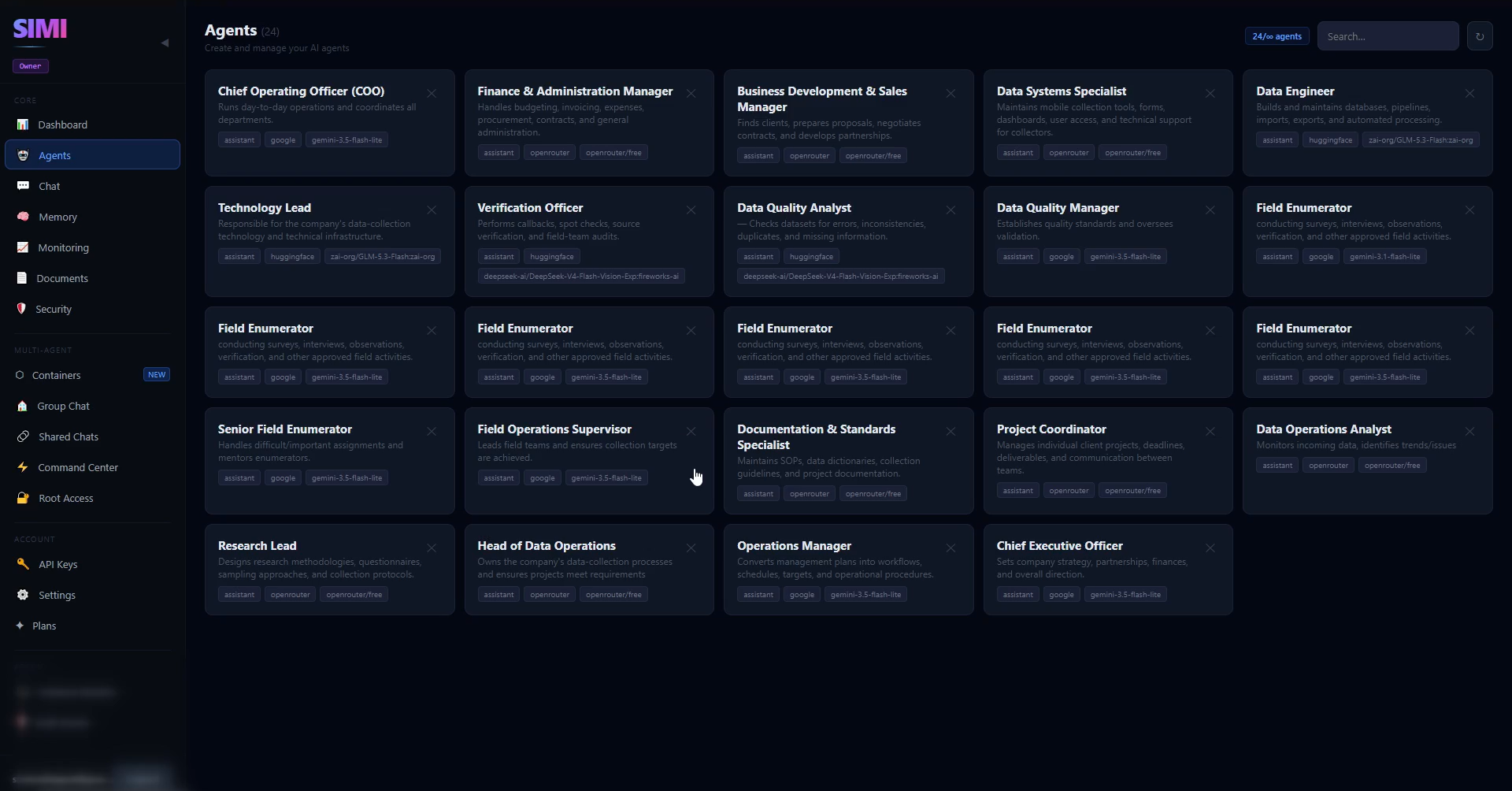
The completed Veridata workforce: all 24 AI employees, each with their own role and description, listed in the Agents section.
Why Personalized AI Employees Matter
Giving every AI employee a defined role creates structure.
For example, the CEO can receive leadership-related responsibilities, while the Research Lead can focus on research tasks. A Project Coordinator can focus on project-related work, while Field Enumerators can handle field-related responsibilities.
This approach creates a workforce where different AI employees can be used for different types of work.
Rather than treating AI as one assistant, you can organize AI around roles, responsibilities, and workflows.
The Foundation of an AI Company
The 24 employees created for Veridata become the foundation for everything that follows.
Once they exist, we can begin assigning individual tasks to them.
We can also ask multiple employees to work on the same topic, share their conversations, merge their work, allow new employees to continue existing work, and create groups where employees collaborate.
The final stage can even involve autonomous AI employees working together with minimal human intervention.
Conclusion
Creating personalized AI employees is the first step in building Veridata.
We start inside SIMI, create the CEO, COO, and Operations Manager, then create the remaining employees until we have 24 AI employees with different roles and responsibilities.
After verifying the employees and their descriptions, the foundation of our AI company is ready.
The next step is to put this AI workforce to work.
Build Your Own AI Company with SIMI
Create personalized AI employees, assign their roles, and start building your own AI-powered company inside SIMI.
Explore SIMI